Crop Rotation for Home Vegetable Gardens
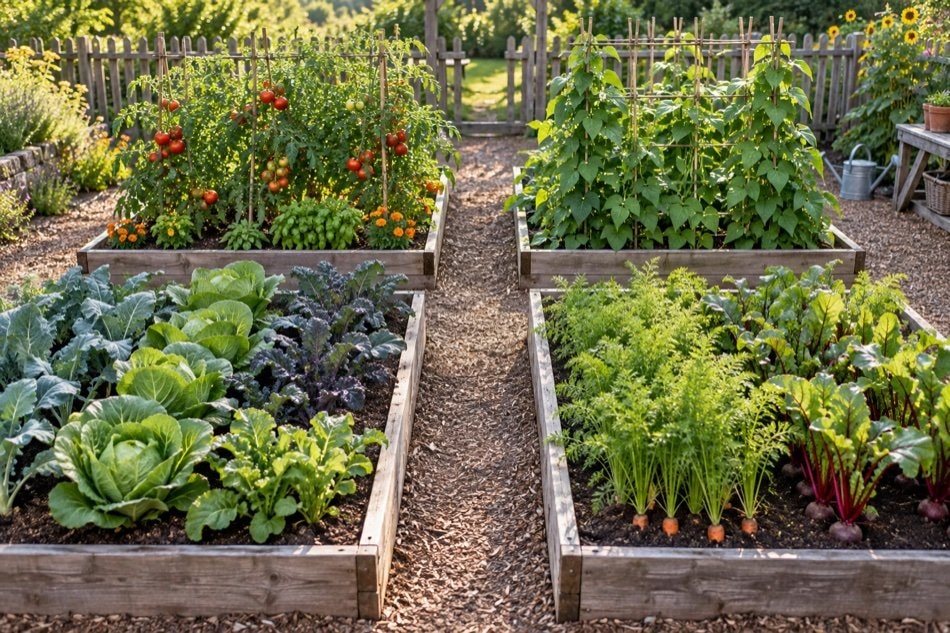
Crop rotation means changing what grows in a bed over time. A useful rotation is less about a rigid chart than about avoiding the same crop family in the same ground season after season.
Why Plant Families Matter
Closely related crops often attract similar pests and diseases and draw on the soil in comparable ways. Tomatoes, peppers, eggplants and potatoes belong to one family; cabbage, kale, broccoli and radishes belong to another. Moving from tomato to pepper may look like change, but from a rotation perspective the bed has hosted the same family again.
Rotation can make recurring problems less convenient for organisms that persist near last year's host. It also encourages gardeners to vary rooting depth, residue and cultivation. It is not a guarantee against disease: wind, transplants, tools and neighboring gardens can move problems. Combine rotation with clean planting material, observation and the practices in plant disease prevention.
Map What You Grow
Draw permanent beds as numbered shapes, then list each planting by family. Include both spring and fall crops, cover crops and volunteers you allowed to remain. A bed that held early peas and autumn cabbage has two rotation entries. Keep the map with seed records so it survives longer than the fading plant labels outdoors.
If family names are hard to remember, group crops in a reference list. Keep unusual cases visible: beets and spinach are relatives, as are carrots, parsley and dill. The objective is not botanical trivia; it is a consistent way to notice repeated occupancy.
Build a Flexible Sequence
Start with the families that occupy the most space. Give each a different bed or group of beds, then move them forward one position the next year. Fill remaining areas with smaller families, herbs, flowers and cover crops. A longer interval is useful where space allows, but even a simple change is better than planting by habit.
Do not force a rotation that ignores light, trellises or soil conditions. Tall crops may always need the north edge, and perennial asparagus should remain in its dedicated bed. In a tiny garden, rotate among containers, replace potting mix when appropriate, or grow a problem family less frequently while emphasizing sanitation.
Fit Succession Planting Into the Plan
A bed can host several short crops in one year. Plan by windows: an early cool-season crop, a main warm-season crop and an optional autumn crop. The succession planting guide helps with timing, while the rotation map prevents those quick successions from becoming invisible.
Follow heavy-residue crops with plants that are easy to transplant through the remaining mulch, and avoid scheduling a sensitive seedbed immediately after a difficult-to-terminate cover crop. Rotation is partly about biology and partly about making the work flow.
Use Rotation as a Diagnostic Tool
Add brief notes on major pest pressure, disease symptoms and unusually weak growth. If the same problem appears whenever a family enters one bed, investigate drainage, shade, soil compaction or irrigation there. If it follows the family from bed to bed, look more closely at seed, transplants, crop debris and likely host-specific issues.
Harvest records add another layer. A family that declines throughout the garden may need different varieties or planting dates rather than a new position. Keep conclusions tentative until more than one season supports them.
Review the Map Each Winter
Before ordering seed, place next season's main crops on a copy of last year's map. Check family history, access, sun and water. Leave room for experiments, because weather and appetites change. At season's end, update what actually happened rather than preserving the ideal plan. Over time, the map becomes one of the most valuable pages in your garden journal.
A Small, Useful Trial
Take last season's map and mark every bed occupied by the tomato family, cabbage family, legumes and onion family. Draft next season on tracing paper or a copy, moving the largest family blocks first. Then check sun, trellis and irrigation constraints. Where a move is impossible, note the sanitation and monitoring steps that must carry more of the risk-management work.
Use one color for each crop family and mark both the planned planting and what actually occupied the bed. If a crop fails early and another takes its place, keep both entries. Review the map from the perspective of the following season: recurring host families, trellis positions, perennial beds and fall successions should all be visible. The map works when another gardener could reconstruct the bed history without relying on plant labels or memory.
Rotate the Family, Not Just the Crop
Switching from tomatoes to potatoes is not a family rotation. Keep a one-page crop-family key beside your bed map.