Reduce Hand, Wrist and Grip Load While Gardening
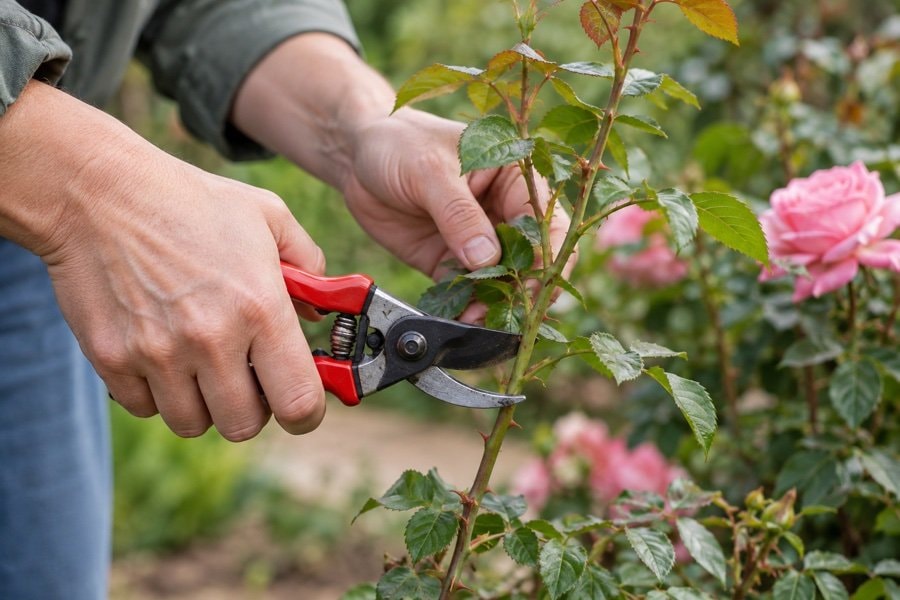
Hands often feel garden work first because pruning, pinching, pulling and carrying repeat the same small motions. Reducing force is more useful than simply squeezing harder.
Identify the High-Load Motions
Notice when the wrist bends while force is applied, when a handle creates a pressure point and when one hand performs every cut. Repetition, force and awkward posture can combine; the public-health ergonomics risk guide lists those factors as reasons to redesign a task.
Common garden examples include deadheading a long border, holding a trigger nozzle, pulling established taproots and carrying thin bucket handles. Mark the first point at which the grip becomes less controlled. That is the signal to change tools or tasks.
Keep the Wrist Near Neutral
Arrange the work so the hand follows the forearm rather than bending sharply up, down or sideways. Raise a pot onto a bench for detailed work and approach stems from an angle that lets the cutting blades align naturally. Move your body instead of reaching the wrist around a branch.
Use two hands on long handles and keep elbows comfortably near the sides. A handle that is too short may force both the back and wrist into awkward positions.
Reduce Cutting Force
Match pruners to the stem size and cut live stems with the appropriate clean, sharp blade. If the tool will not close with comfortable pressure, step up to a longer-handled lopper or pruning saw rather than forcing repeated squeezes. Never twist the pruner sideways to finish a cut.
Clean sap from blades and sharpen them according to their bevel. Lubricate the pivot and check that the spring opens smoothly. Maintenance reduces both force and the temptation to grip excessively.
Change Handle Size and Contact
A slightly larger, nonslip grip can spread pressure across more of the hand. Add-on sleeves must be secure and should not interfere with triggers, locks or the tool's safe operation. Test a handle with gloves actually worn in the garden.
Use buckets with broad handles or carry two light containers, one in each hand, to balance the load. Do not loop thin handles over fingers for a long walk. A cart is a better choice when the grip must remain tight simply to prevent dropping.
Rotate Fine and Broad Tasks
Alternate ten minutes of detailed pinching or pruning with an open-hand task such as placing labels or moving lightweight mulch. Switch hands for simple low-risk actions when coordination permits. Set a small pruning target and put the tool down at the end of it.
The broader pacing guide helps arrange work blocks before repetition accumulates. For overhead cutting, also use the reach limits in shoulder and overhead work.
Take Symptoms Seriously
Stop if pain becomes sharp, grip control changes or numbness and tingling appear. Persistent, worsening or recurrent symptoms should be discussed with your own clinician, who can account for your health and activities. Garden content cannot identify the cause.
For routine prevention, keep a small set of well-fitted, sharp tools close to each work area. The ergonomic tool guide provides a test sequence for weight, balance, handle shape and controls. Comfortable hands come from reducing demand, not from proving how long they can hold on.
A Small, Useful Trial
Prune one small, appropriate section with a cleaned and sharpened tool, consciously releasing the handles between cuts. Switch to a non-gripping task at a preset stopping point. Compare this with your usual tendency to carry the pruner clenched. If control, comfort or cut quality worsens, stop and reassess tool fit rather than extending the trial.
Record the tool condition alongside the task: blade cleanliness, pivot movement, handle fit with gloves and the largest stem cut comfortably. Keep a small container nearby so the tool can be put down safely between work blocks. If a maintained pruner still demands a hard squeeze, assign thicker stems to a suitable longer-lever tool rather than extending the comparison. The result to preserve is controlled cutting with a relaxed release, not the greatest number of cuts in one session.
Let Go Between Cuts
Do not keep a pruner clenched while walking or inspecting. Lock it safely or place it in a holster, and let the hand open fully.