Knees and Kneeling: Ground-Level Garden Work
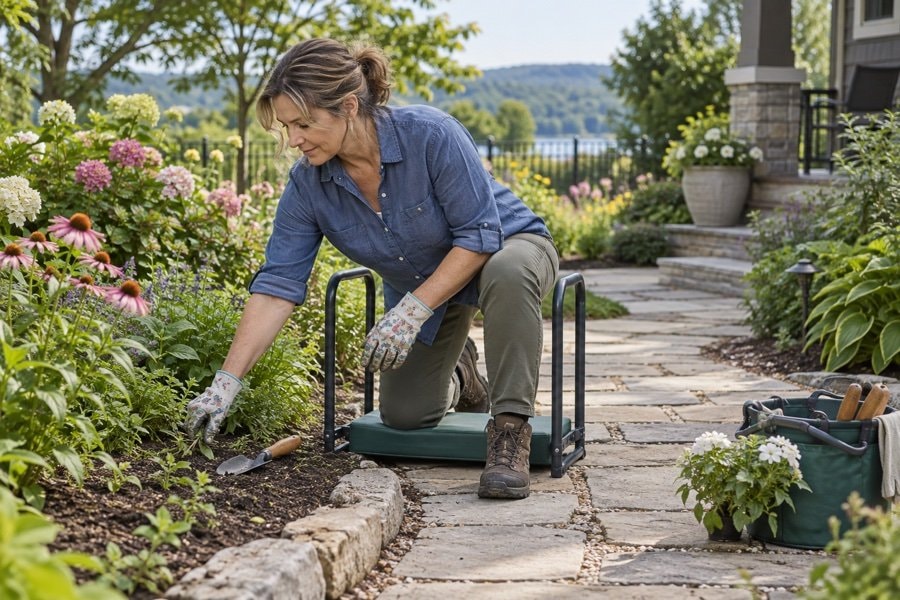
Kneeling is not the only way to work near the soil. Pads, stools, long-handled tools and better bed dimensions let you choose a position instead of staying trapped in one.
Set Up Before Going Down
Place the needed hand tools, waste container and support within easy reach before kneeling. Clear stones, irrigation fittings and hidden stakes from the work zone. A flat, dry path gives the pad or kneeler a dependable base and makes the return to standing more secure.
Keep the task narrow: one short row, one planting cluster or one bucket of weeds. Ground-level jobs expand easily, and the hardest moment often comes when a gardener tries to stand after remaining still too long.
Choose Support That Matches the Surface
A thick pad spreads contact over a larger area and works well on level ground. A framed kneeler with handles can help with lowering and rising, but only if it is stable, correctly oriented and used on firm soil. Test it beside a solid support before carrying it to a sloped or loose path.
A low garden stool or rolling seat removes direct knee contact. Check that the seat will not tip when you reach sideways and that wheels cannot roll unexpectedly. On gravel or uneven ground, a wide fixed base is often more predictable than small wheels.
Vary the Position
Change between both knees, half-kneeling with one foot forward, sitting and standing tasks. Keep the working area in front of you and shift the pad instead of twisting far to the side. Bring a seed tray up onto an overturned crate so repeated reaches are shorter.
Do not rest a knee directly on sharp edging or use a wet, compressed pad that no longer cushions. If one position is uncomfortable, switch methods rather than trying to finish the row through it.
Plan a Controlled Way Up
Move near a stable support, bring one foot forward, keep the foot flat and rise gradually while using the legs and hands as needed. Avoid pulling on a loose trellis, flexible stake or wheelbarrow that can move. A kneeler's handles help only when all four contact points are planted firmly.
Stand still for a moment before walking away, especially after a long low task. Keep paths free of hose loops and tools so the first step is uncomplicated. The balance and pacing ideas in gardening after 50 are useful at any age.
Bring the Task Higher
Use long-handled weeders, bulb planters or hoes for jobs that do not require close inspection. Place potting work on a stable table, harvest into a waist-high cart and grow frequently tended plants near an edge. For a permanent change, explore seated and standing-height garden setups.
Bed width is crucial. If the middle cannot be reached without leaning hard onto the edge, narrow the bed or add an access point. Never step into wet growing soil simply to avoid moving around the bed.
Respond to Pain Sensibly
Sharp, sudden or increasing pain is a reason to stop the task, not to add another pad and continue. Swelling, instability, an injury after a fall or symptoms that persist deserve advice from your own clinician. Garden technique cannot diagnose a joint problem.
For ordinary task planning, use shorter work blocks and alternate with upright jobs such as labeling or light watering. Review pacing a garden day before a planting marathon. The most useful support is the one that keeps you changing position and leaves a safe route back to standing.
A Small, Useful Trial
Set up the same ten-minute weeding job three ways on firm ground: with a pad, from a stable stool and with a long-handled tool. Keep the reach narrow and plan the rise before each low position. Record comfort, control and how much cleanup each method creates. Keep more than one option because soil conditions and task detail will change.
Repeat the comparison on the surfaces where garden work actually happens, without using any support that rocks or slides. Move the pad or seat whenever work drifts outside a comfortable forward reach; do not twist to preserve a fixed position. Include the transition down, the task itself and the return to standing in the assessment. A method is practical only when tools stay reachable, footing remains clear and the gardener can stop at any point without an awkward scramble.
Plan the Exit
Before kneeling, identify the stable support you will use to rise. Do not rely on a nearby trellis or cart unless you have confirmed it cannot move.