Adaptive Gardening Tools and Techniques
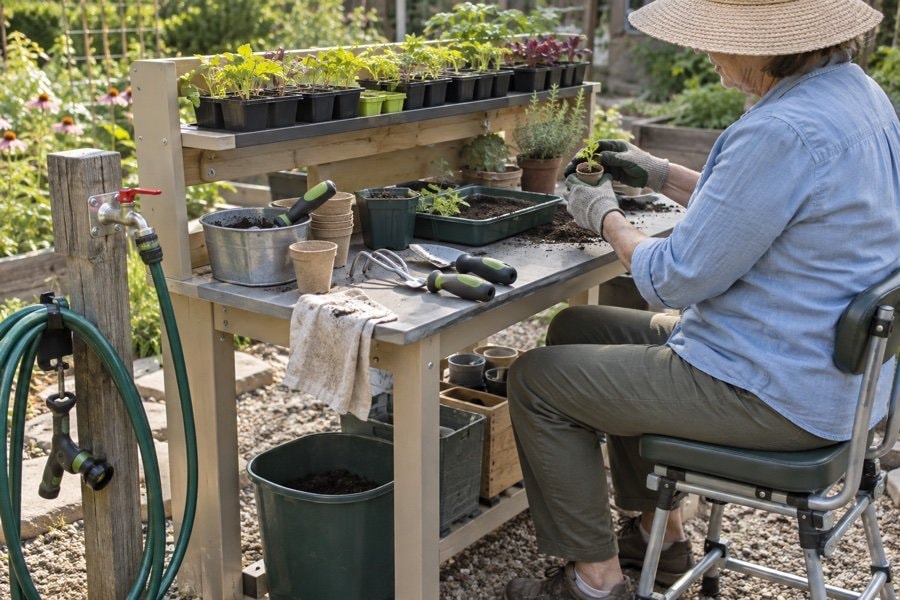
Adaptive gardening begins with a specific obstacle: a reach that is too long, a grip that is too narrow or a route that requires too many transfers. Solve that obstacle, then test the change in real work.
Break the Task Into Motions
Watch one complete job from setup to cleanup. Planting a container may include carrying mix, opening a bag, scooping, holding a plant, firming soil, watering and moving the finished pot. The most difficult motion may be hidden in the middle.
Change one part at a time and observe the result. The public-health ergonomics overview describes fitting tasks, tools and equipment to people's capabilities. This practical sequence applies well beyond a workplace.
Adapt Grip and Controls
Build up a hand-tool grip with a secure, washable sleeve that does not rotate or block a lock. Use trigger adapters or shutoff levers that can be operated with less sustained squeeze. Test every modification under a light load before regular use.
Keep cutting tools sharp and select a longer-lever tool when appropriate. A modification should preserve blade guards, locking parts and safe hand placement. If it makes the tool harder to control, remove it.
Extend Reach Carefully
Long-handled trowels, hoes and fruit pickers can bring work closer, but extra length changes balance. Use the shortest extension that reaches comfortably and keep the work in front of the body. Do not use a long conductive tool near power lines.
Place containers on stable stands, train vines along reachable wires and use a pulley designed to lower a hanging planter securely. Permanent design is often more dependable than using a reacher for every visit.
Simplify Sowing and Planting
Mix very small seed with a dry visible carrier when appropriate, use a simple seed spacer or sow into larger cells at bench height. Prelabel rows and prepare holes before opening packets. Work over a tray so dropped seed remains contained.
Use transplants when direct thinning would demand too much close hand work. Choose larger seeds and compact varieties for selected beds, while keeping favorite challenging crops in a smaller, reachable area.
Move Water and Materials Differently
Split loads between two light buckets, use a stable cart and arrange delivery near the final bed. Connect short lightweight hose segments with reachable shutoffs. Drip irrigation can remove daily carrying when lines are easy to inspect and repair.
At a potting bench, store mix in a waist-height bin and use a small scoop. Slide containers across a smooth work surface rather than lifting them repeatedly. The lifting principles in digging and hauling still apply to adapted setups.
Design for Safe Failure
Ask what happens if a grip slips, a wheel catches or a valve remains open. Keep sharp tools pointed away, lock cart wheels and route overflow to a safe place. Use contrasting colors on edges and handles when visibility helps.
If a disability, health condition, injury or recent procedure affects movement, ask your own clinician or therapist for individualized guidance before changing activity. Then pair that guidance with seated and standing workstations or tool fit. The strongest adaptation is simple, stable and easy to repeat independently.
A Small, Useful Trial
Choose one exact barrier in a common job, such as holding a trigger while watering or reaching labels at the back of a tray. Make one reversible adaptation, test it under a light load and check what happens if the grip slips or the tool is set down. Keep the change only if control and safe storage remain straightforward.
Evaluate the adaptation in three moments: while working, when the tool is released and when it is stored. A larger sleeve that lowers grip demand may still roll on the handle; a reach extension may become unwieldy when carried; a hose control may be easy to open but difficult to shut quickly. Correct those failure points before regular use. Photograph the final setup and label any special locking or storage step so another helper can return it safely.
Solve One Motion
Name the exact reach, squeeze, lift or transfer that blocks the task. A precise problem is much easier to redesign than “gardening is difficult.”
Keep useful adaptations together at the point of work instead of returning them to a distant general shed. A shallow caddy can hold the grip sleeve, seed spacer, labels and small scoop for one station. Give every sharp item a secure slot and keep the total caddy weight manageable. If setup requires assembling many small parts, store the working arrangement intact so the easier method remains the convenient method.